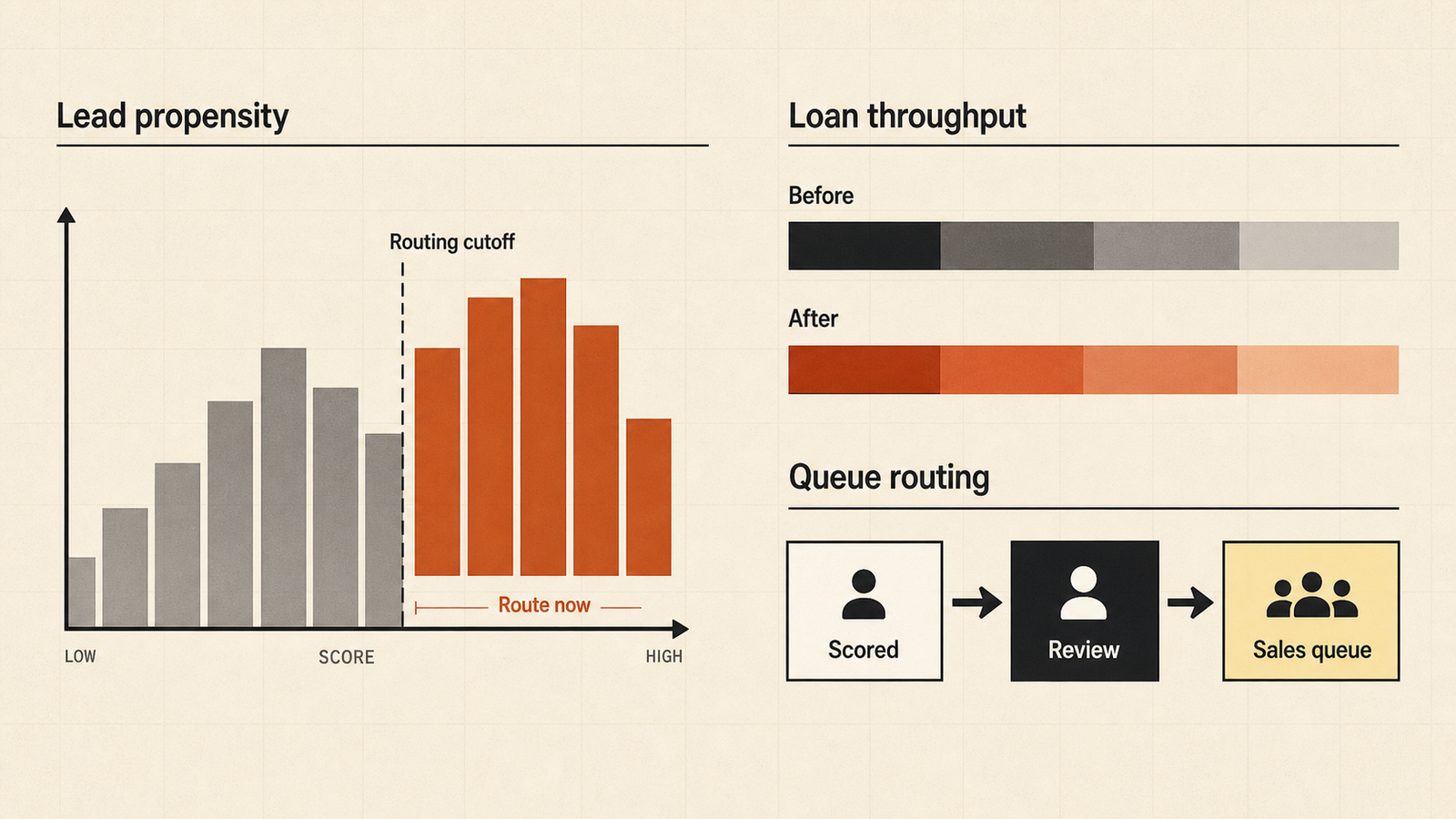
The lender did not need a chat interface. It needed sharper judgment baked into the daily routing — which leads to prioritize, which loans to move first, and where throughput was quietly bleeding out.
Lead volume was huge and sales capacity was fixed, which made every small ranking error expensive.
Recommendations had to lift conversion without starving downstream teams or pushing queues out of balance.
The model had to live in a regulated environment, which meant explainability, auditability, and operator control were table stakes.
Propensity ranking
We trained a selection model that scored likelihood of conversion on historical lead, borrower, channel, and interaction signals — then calibrated the output so a human reviewer could read it without a stats degree.
Throughput optimizer
A second layer treated the loan flow as a constrained operation and pointed at the queues and handoffs that were doing the most damage to crossing time.
Human-in-the-loop controls
The system shipped with cutoffs, review bands, override reasons, and monitoring so managers could tune capacity without flattening the model's signal in the process.
- Benchmarked against the existing lead selection process before changing any routing.
- Surfaced recommendations inside a review workflow first, so managers could see the score, the rationale, and the operational effect side by side.
- Once the first model proved real lift, extended the work from lead ranking into loan-throughput optimization.
Propensity lift came in around fifty percent over the prior baseline.
Qualified lead volume roughly doubled, mostly because capacity was being spent on better-ranked opportunities.
Crossing time dropped from thirty-one days to twenty-nine — not from generic automation, but from naming the operational constraints and working on those.
Not every AI win has to be an agent. In high-volume operations, a well-calibrated ranking model and a sober queue optimizer will usually beat anything with a chat interface on it.