Small businesses and startups do not need a six-month AI strategy deck. They need a fractional AI lead embedded in the business — someone who can pick the one workflow where automation pays for itself this quarter, ship it on the tools the team already uses, and stay close enough to tune it over the next two or three iterations.
The team knew AI mattered. Every vendor pitch they heard was either too generic, too expensive, or aimed at a company three sizes bigger than them.
The work that actually mattered sat in the messy spaces between tools — inbound leads, follow-up, proposals, internal knowledge, the repetitive admin nobody wanted.
They could not pause to hire a full AI team or migrate the stack, and a heavyweight transformation program was a non-starter.
Operating map
Two weeks of structured mapping of the business as workflows instead of software categories — demand sources, time and quality leaks per step, integration surface — output as a ranked shortlist of automation candidates scored on impact, feasibility, and time to first measurable result.
First useful system
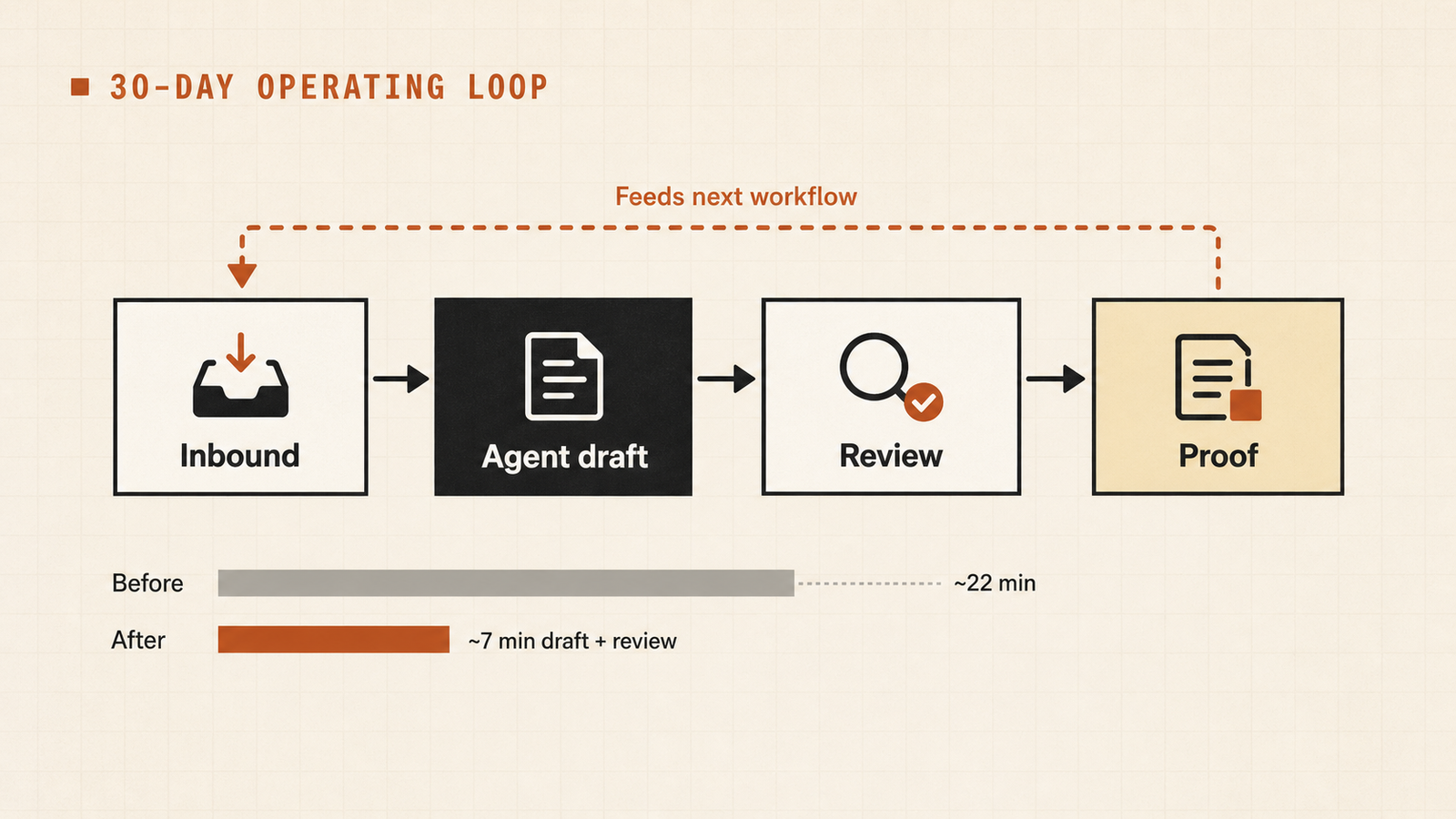
The first build sat on top of the tools they already used, added agent-assisted drafting and follow-up, and kept a human review step in the loop so operators stayed in control.
Growth proof loop
Once the workflow was live and adopted, we packaged the before-and-after — workflow diagram, adoption signal, time-saved measurements — into a long-form case study the company published on its site and reused in sales, hiring, and investor materials.
- Week one: pick the workflow with the clearest business outcome and enough volume to actually tell if AI is helping.
- Weeks two to four: ship the first automation or agent loop on the existing stack, with a human review step and simple measurement built in.
- Month two onward: tune it, train the team, pick the next use case, and turn the first launch into a written case study the company can put on the site and use in pitches.
The business got an AI-native capability without waiting for a full-time hire.
The first workflow became a template for the next one — not a one-off science experiment.
The launch produced a real case study the company could promote: what changed, how it works, why the team is faster now.
For lean operators, the right engagement is an embedded AI lead, not a transformation program. Ship one workflow on the existing stack, hand it back instrumented and owned by the team, and turn the launch into a piece of proof the business can sell with.