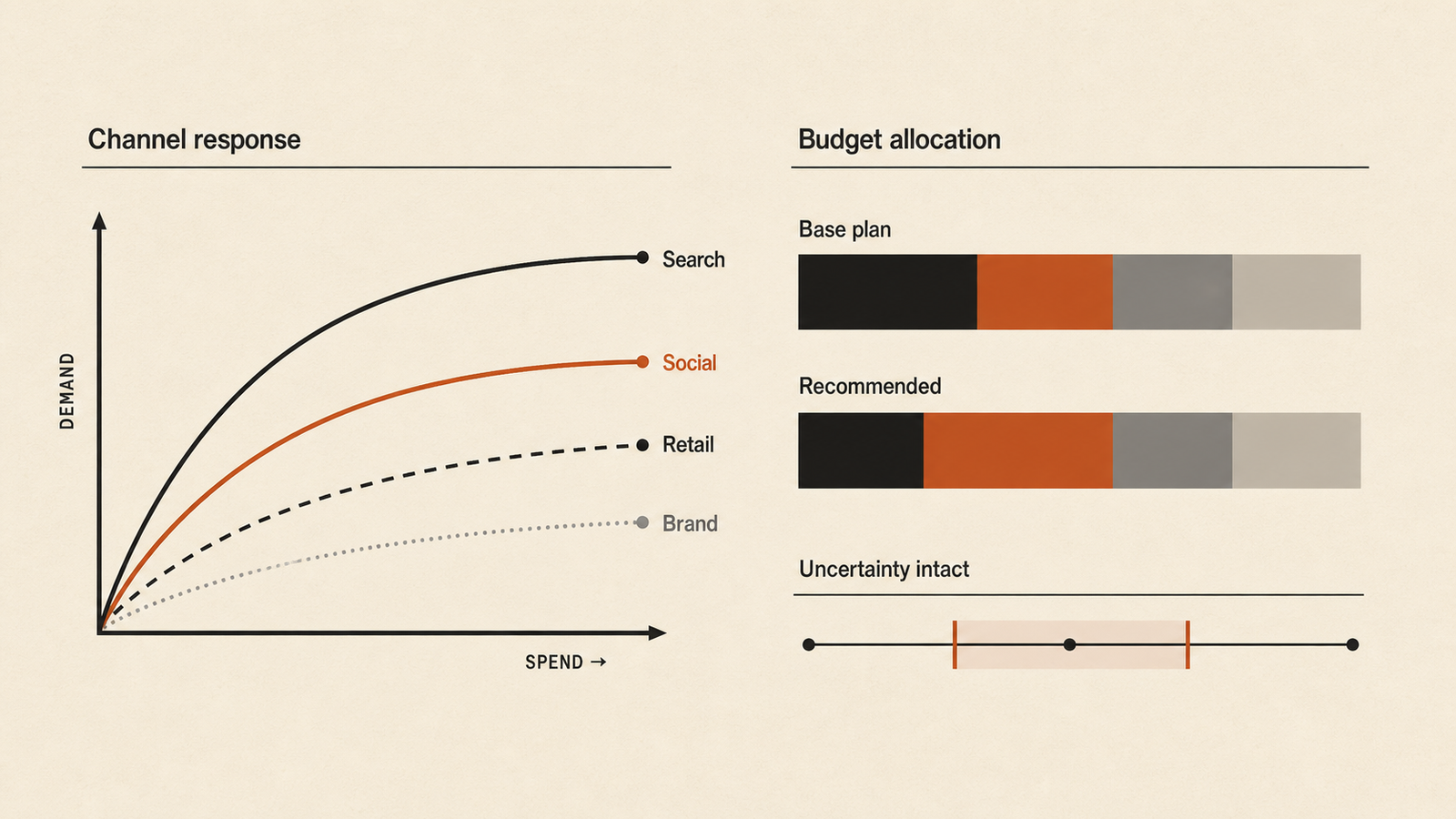
What the team needed was a planning system that joined marketing spend, demand signals, and the real planning constraints into a single model executives could defend in a budget meeting — with the posterior uncertainty intact, not flattened into a single point estimate.
Channel teams had different stories about incrementality, which made budget conversations political instead of analytical.
MMM outputs were great for data science and useless for the leadership meeting that changed direction every planning cycle.
The forecast had to handle campaign launches, seasonal shifts, and channel saturation without pretending the model knew more than it did.
Meridian modeling core
We used a Meridian-style MMM workflow to estimate channel contribution, saturation, lag effects, and uncertainty — in a structure the analytics team could maintain after we left.
Scenario optimizer
A proprietary optimizer translated the model into budget allocations across search, social, retail media, and brand, while honoring the constraints planners already used.
Executive explanation layer
The AI layer explained which channels were constrained, where spend had saturated, and how the plan shifted under alternate demand or budget assumptions — in language an exec wanted to read, not in a notebook.
- Reconciled channel, spend, calendar, and demand data into one modeling table, with the assumptions written down instead of implied.
- Built a scenario interface around the model so executives could compare plans live instead of reading a static deck.
- Added drift monitoring and an assumption review cadence so the model kept earning its keep after the first planning cycle.
Budget planning shifted from channel-by-channel justification to a portfolio conversation with the tradeoffs visible.
The analytics team could defend recommendations with model evidence, uncertainty, and constraints in one place.
The planning layer became the base for later demand forecasting and campaign simulation work.
MMM is only valuable when it leaves the notebook. The actual win is the layer around the model — scenarios, constraints, explanations, and a review cadence that keeps the forecast honest as the world changes under it.